
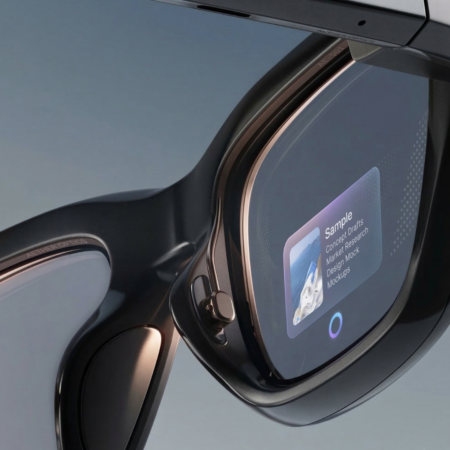
Many technology leaders increasingly point to AI glasses as the device that could unlock the next generation of human AI interaction. Unlike smartphones or laptops, glasses allow AI to operate seamlessly within the user’s real-world context.
AI works best in first person context
Most AI interactions today still rely on screens. We open an app, type a prompt, or issue a command through a device. AI glasses change that interaction model entirely. With cameras, sensors, and microphones embedded in the frame, AI can interpret the environment from the user’s perspective. This first-person perspective allows AI to provide assistance that is directly tied to the physical world.
Consequently, innovations such as real-time translations, contextual information alongside navigation and productivity support become readily available. Unlike smartphones, which often pull attention away from the real world, glasses allow digital information to appear seamlessly within the user’s field of view.
Ambient and “Always On” interaction
Related to AI Glasses being able to operate best in a first-person context, the Glasses also enable a different form of computing: ambient AI. Rather than requiring users to actively launch an application, AI can operate quietly in the background and provide information when it is relevant. This creates much more natural interaction.
A familiar device used by billions
Another major advantage of glasses is their existing global adoption. More than 4 billion people worldwide already wear glasses. This makes them one of the most socially accepted and widely used wearable devices. Because of this, smart glasses have the potential to scale much faster than entirely new hardware categories.
The optical challenge behind AI glasses
To project digital information into the user’s field of view while keeping lenses transparent, AI Glasses rely on advanced optical waveguides. These waveguides require precise nano-scale structures that manipulate and guide light inside thin glass layers. Manufacturing these structures at scale is one of the biggest technical challenges in bringing AI glasses to mass adoption.
At Morphotonics, we bring AR waveguide manufacturing to scale through our Roll-to-Plate (R2P) nanoimprinting technology. Our latest platform, Cypris, is the first high-volume manufacturing system purpose-built to remove the waveguide production bottleneck and accelerate the rise of AI glasses. Cypris is the only scalable and cost-efficient manufacturing platform for AR waveguides, delivering consistency, accuracy and throughput required for true mass production.
To learn more, read our Cypris press release
