
Advanced Screens Lenticular Lenses
What are lenticular lenses?
A lenticular lens is a sheet of long, narrow lenses arranged in a repeating pattern. Each lenticule curves in one direction only, like a slice of a cylinder, so the array controls the direction of light along one axis.
Placed over a printed image or display, the array sends different parts of the images toward different viewing angles. This can create effects such as depth, motion or image switching. In a glass-free 3D display, each eye sees a slightly different image, and the brain combines them to create the perception of depth.
Lenticular lens arrays are used in 3D displays, light-field displays, lenticular printing and other visual applications. Their performance depends on how accurately the lens profile and pitch are reproduced across the whole sheet —a field where large-area nanoimprint technology can help produce complex structures at scale.
DEFINITION
lenticular
/lɛnˈtɪkjʊlə/
From Latin lenticula, “lentil.” In optics, describes an array of long, cylindrical lenses (lenticules) that focus light along one axis only.
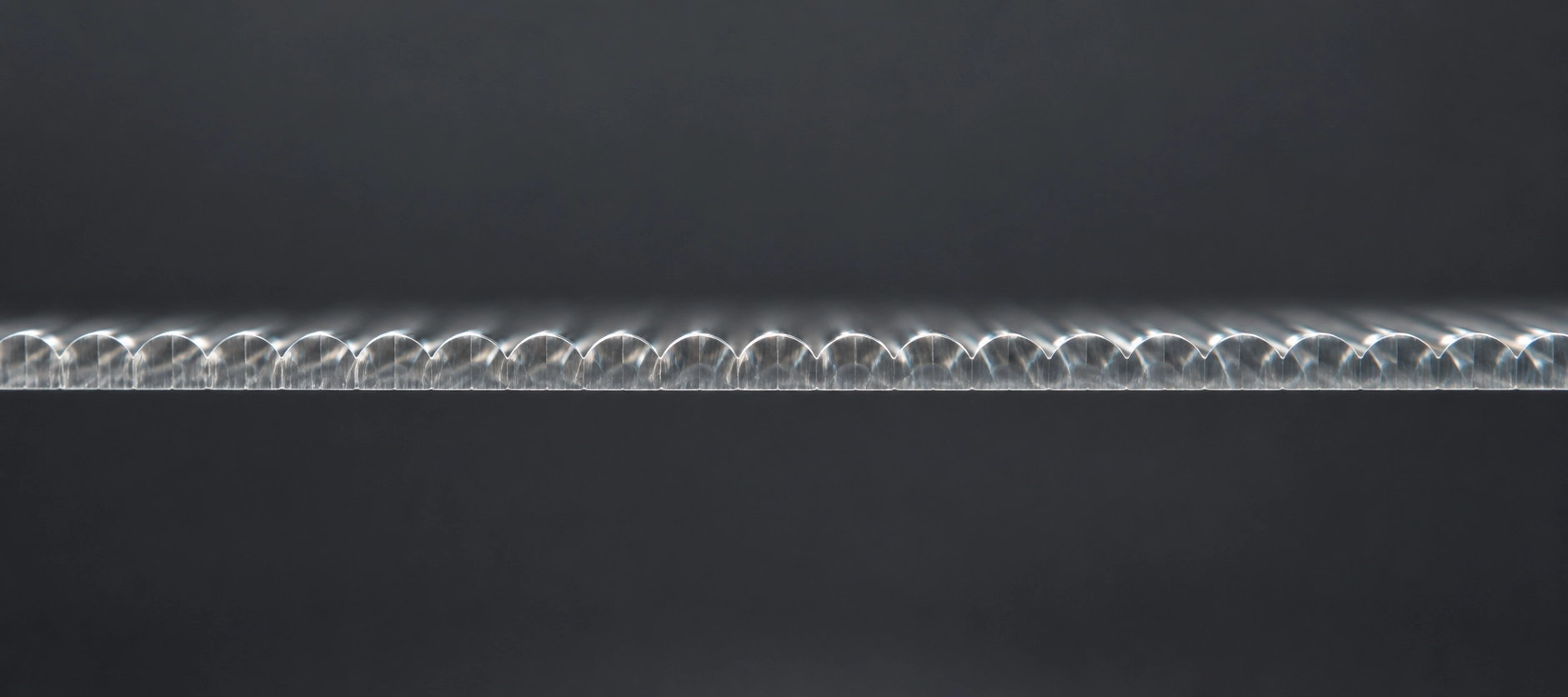
Cross-section of a lenticular lens array: one lens profile, repeated at a precise pitch.
How do lenticular lenses work?
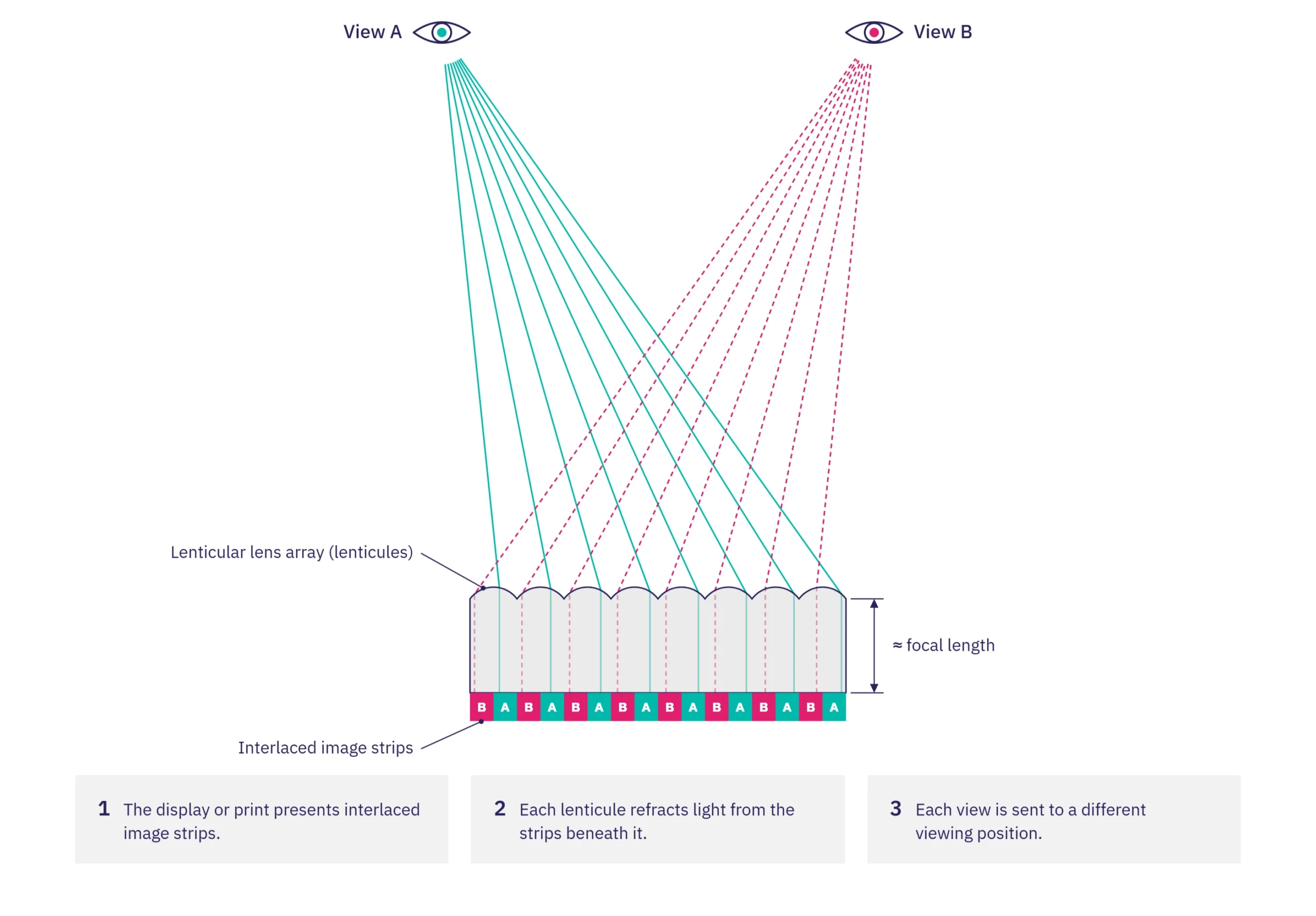
Design parameters shape lens performance
A lenticular array works as part of a complete optical system. Its performance depends on how the lens geometry, material, display pixels and viewing requirements work together. Small design or alignment errors can affect image sharpness, viewing zones and crosstalk.
Lens pitch
The center-to-center distance between lenticules. It must align with the display pixel architecture.
Lens profile
Curvature, height and refractive index together determine focal behavious and angular distribution.
Alignment
Angular and positional registration between the lensa array and pixels is critical for limiting crosstalk.
Viewing angle
The intended number and width of viewing zones influence the complete optical design.
The manufacturing process
Lenticular lens arrays for displays must keep the same lens profile and pitch across the whole panel.Manufacturing them at display scale requires uniform, defect-free replication across large panels, which is where Morphotonics applies Roll-to-Plate NIL via its Aurora platform.
THE CHALLENGE
Repeatable precision
A lenticular array must maintain a consistent lens profile and pitch across the panel to deliver uniform optical performance. Aurora 1100 is Morphotonics’ fully automated Roll-to-Plate nanoimprint platform, designed to replicate optical structures at display scale.
| 1,100 × 1,300 mm | Gen 5 substrate capability |
|---|---|
| Glass, metal, polymer | Rigid & flexible substrates |
| 0.5–10 mm | Substrate thickness |
1
Lens profile design
Define the shape and spacing of the lenticules to suit the display and its intended viewing zones.
2
Prepare the patterned stamp
A precision master is used to create a flexible stamp carrying the lens pattern.
3
Apply the optical resin
A layer of UV-curable resin is applied to a glass, polymer or other substrate.
4
Replicate the pattern
In Morphotonics’ Roll-to-Plate process, a roller presses the flexible stamp into the resin across the substrate.
5
Cure and release
UV light hardens the resin. The stamp is then removed, leaving the lenticular structure replicated on the substrate.
Lenticular arrays and other micro-optics
Lenticular arrays are one of several families of micro-optical structures. Each one shapes light differently and suits different products. The table compares the most common types.
| Primary function | Typical use | |
|---|---|---|
| Lenticular array | Directional imaging in one axis | Glasses-free 3D, multi-view displays |
| Microlens array | Two-dimensional light control | Imaging, sensing, homogenization |
| Fresnel lens | Thin focusing or collimation | Illumination, projection, solar concentrators |
| Diffractive optic | Wavefront control by diffraction | AR waveguides gratings, beam shaping |
Ready to scale lenticular design?
Get in touch with our experts at Morphotonics. Our specialists can help evaluate the route from concept to large-area. high-volume replication.